This is an update on results from this post.
Update:
Experiment details: post here
In my post from 2026-06-10, the EFSW (eelgrass + seawater) treatment had quite a bit of V. pectenicida (see figure in post).
I re-did the analyses based on some reading that I did looking into the appropriate methods of cleaning qPCR data post-run.
Here’s what I did:
- Focus on SQ (Starting Quantity) and SQ Mean.
- Remove any replicates (samples were run in triplicates) if SQ is wayyyy out of range.
- Calculate CV (Coefficient of variance) for each sample (SD/Mean)*100. Tells variance around the mean. Helps determine if a replicate should be removed.
Google sheet with filtering: 2025_water-filter_qPCR_summary_results
So, for each sample:
- Calculate SQ Mean, SD, and CV (only including wells that aren’t contaminated (aka way out of range compared to other replicates of the sample and if CV is way high)).
- The SQ mean is mean amount or V. pec in 2ul of the sample. Divide the mean by 2 to get the amount of V. pec in 1ul of sample
Calculate the amount of V. pectenicida in the whole treatment bag
- Calculate amount of V. p in 1mL of water by multiplying the amount in 1ul of sample times 1000
- Multiply the amount in 1mL by 150 to get the amount in the bag
For each treatment group calculate:
- Mean amount of Vp across samples (n=8)
- Standard Error of Vp across samples (n=8). SE = sd/(sqrt(n))
Create summary results
Mean amount of Vp in 150ml of sample per treatment with error bars (standard error)
Updated R code of creating results figures: eelgrass-vpec/code/02-2025-Expt-results.Rmd
Updated Figures:
| V. pectenicida Per Sample | V. pectenicida Per Sample with y-axis break |
|---|---|
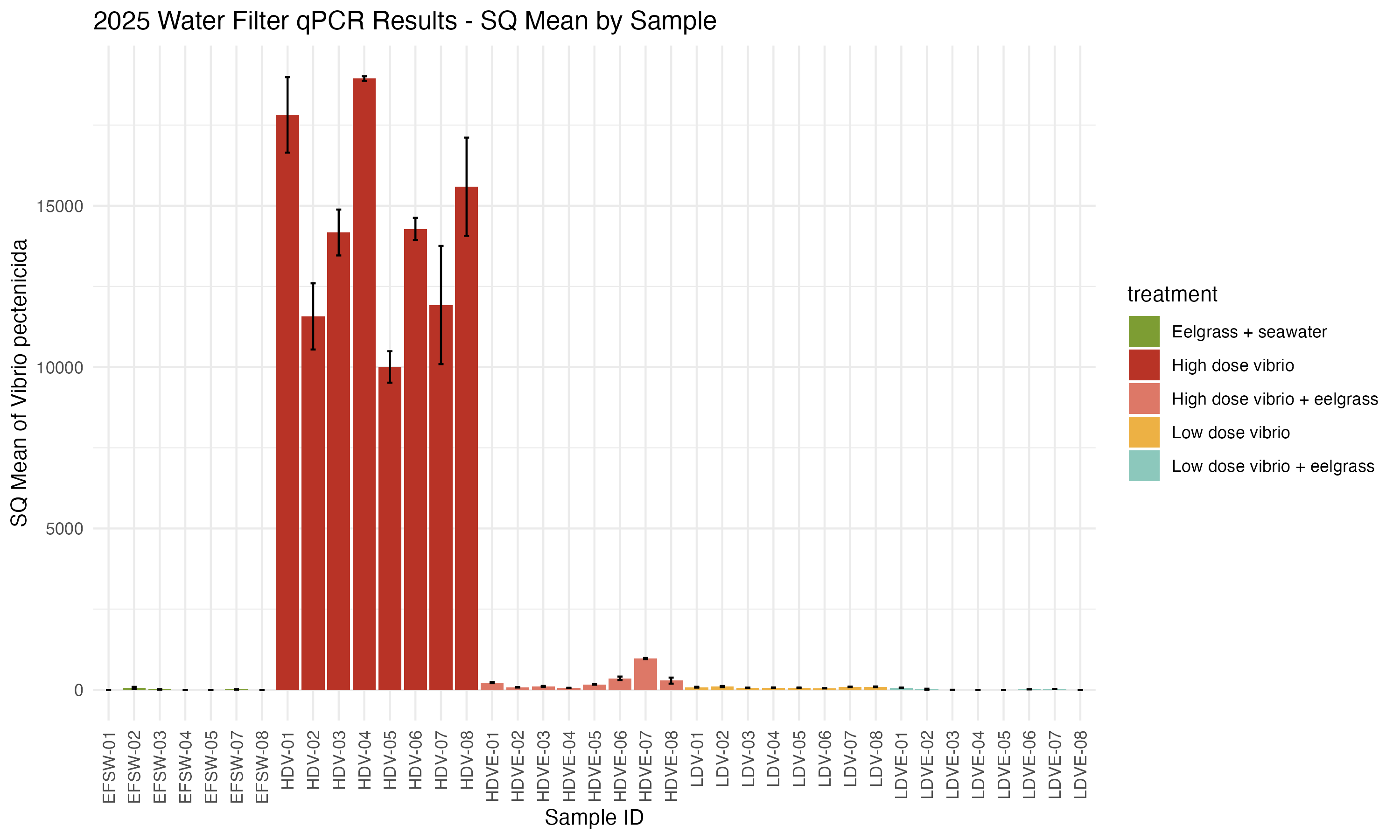 |
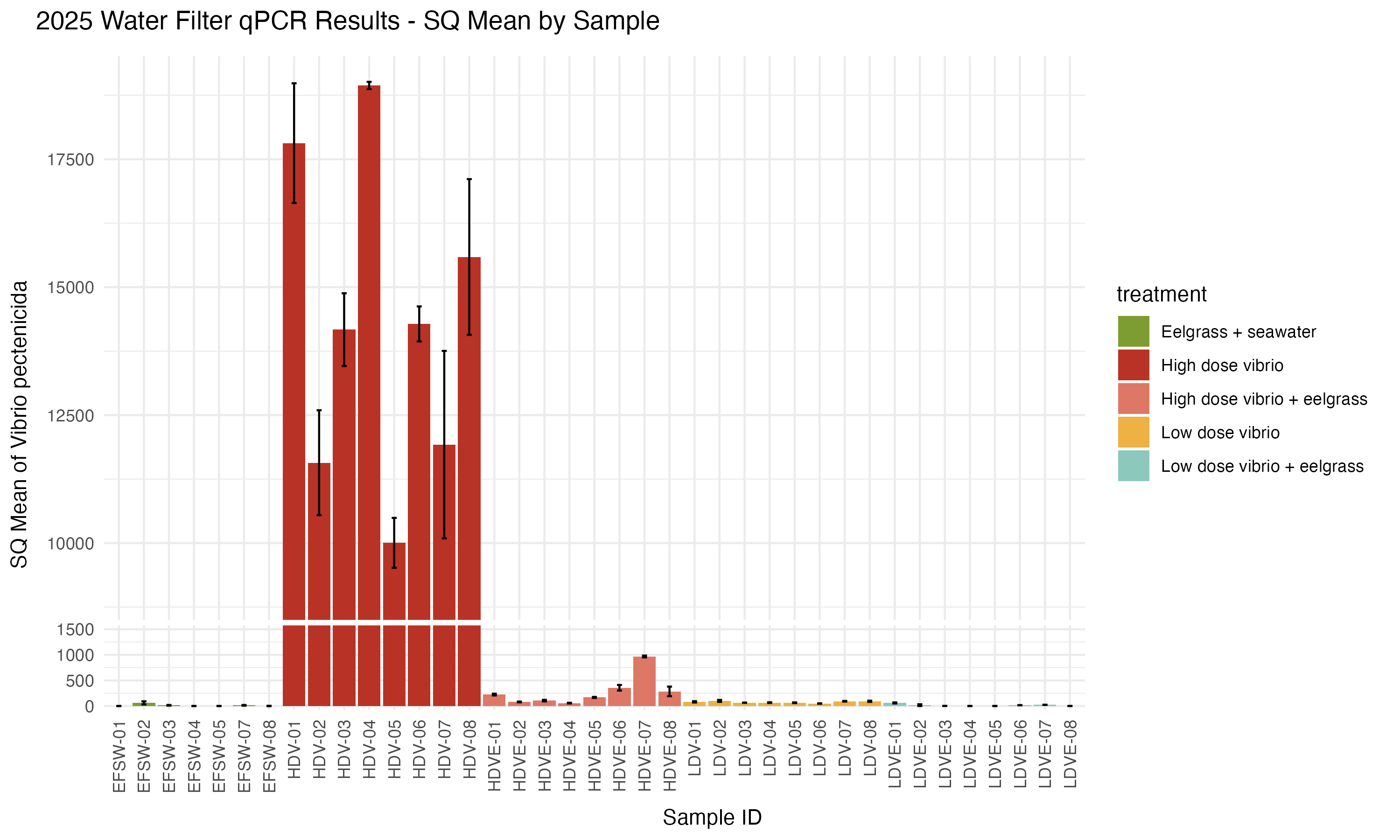 |
| V. pectenicida Per Treatment | V. pectenicida Per Treatment with y-axis break |
|---|---|
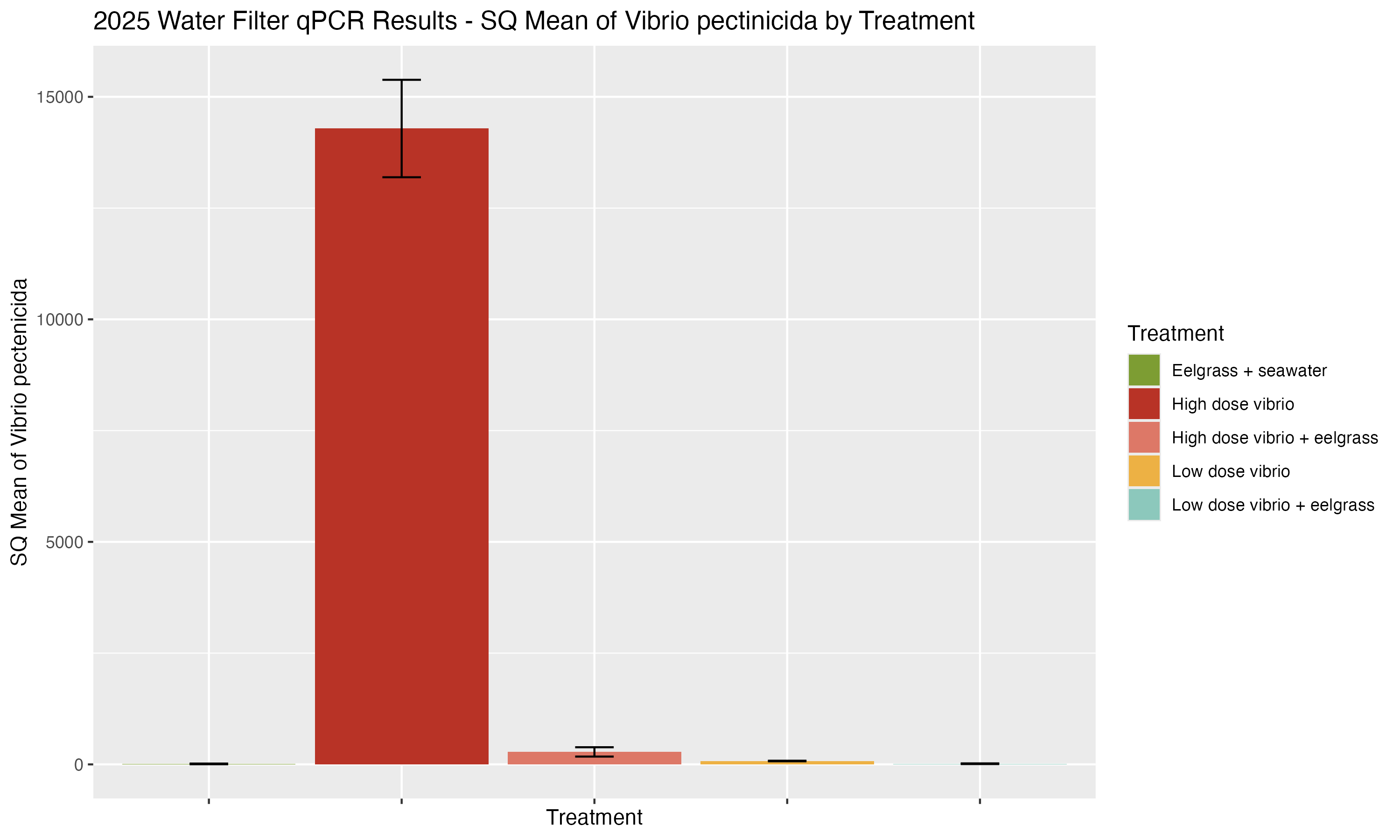 |
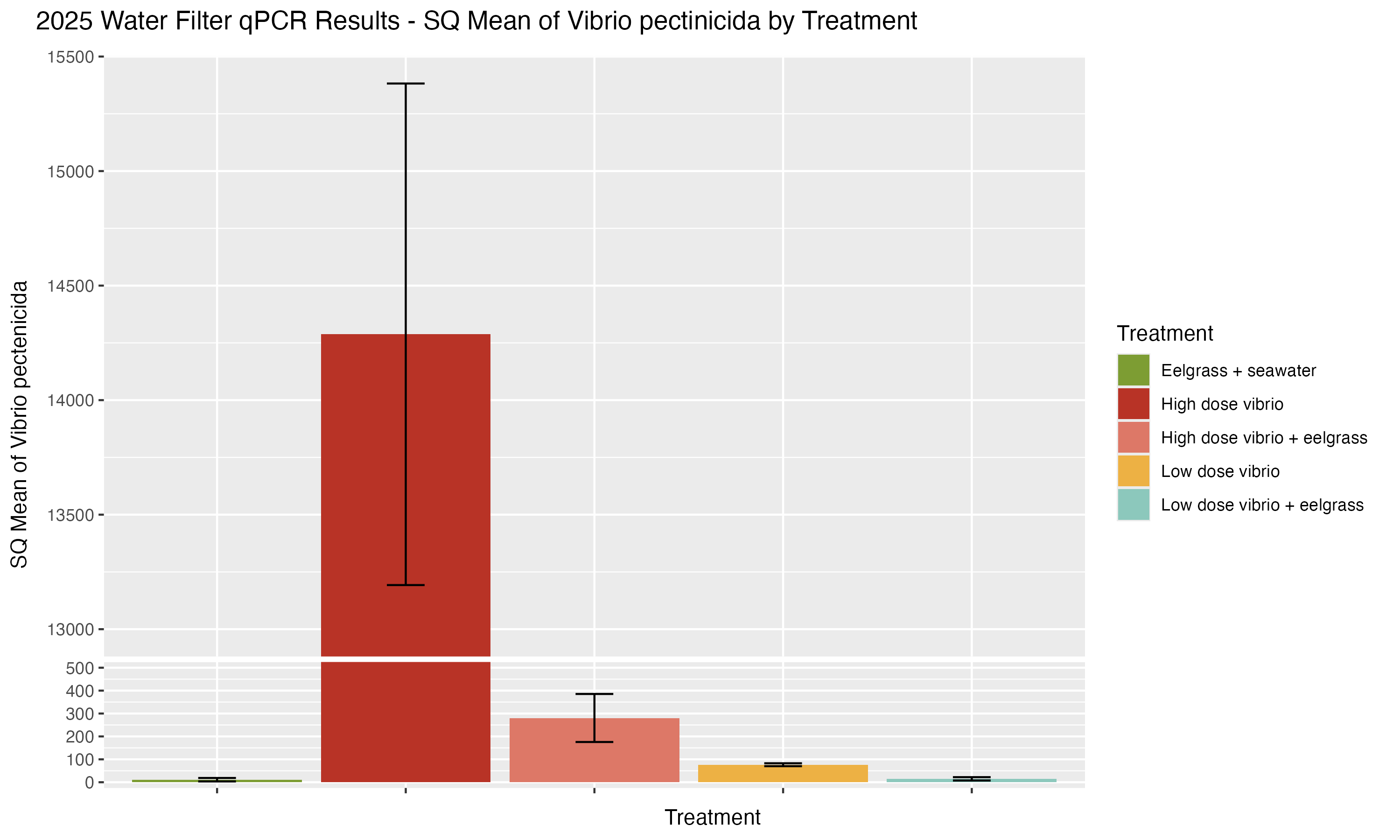 |
With the updated methods of filtering the qPCR results, the amount of V. pectenicida in EFSW treatment is a bit less.
But, I think it does mean that I did have some contamination either during the DNA extraction process, but more likely during the qPCR process.