Details for the experiment run at Friday Harbor Labs this May/June 2026! Can eelgrass and/or mussels decrease the amount of V. pectenicida in seawater?
Question:
Can eelgrass and/or mussels decrease the amount of Vibrio pectenicida in seawater?
Hypotheses:
- Presence of eelgrass will decrease the amount of Vibrio pectenicida in seawater over time.
- Presence of mussels will decrease the amount of Vibrio pectenicida in seawater over time.
- Eelgrass and mussels together will decrease the amount of Vibrio pectenicida in seawater more than either one alone.
The eelgrass is testing the oxygenation hypothesis –> eelgrass produce oxygen which creates an uninhabitable environment for the anaerobic V. pectenicida. The mussels are testing the filtration hypothesis –> mussels filter the water and remove V. pectenicida from the water column.
Mussels (and other bivalves) are known to filter feed, and maybe will be able to filter out the V. pectenicida from the water column, concetrating it in their tissues.
Treatment groups:
| Trmnt Number | Treatment group: | Treatment code | Number of bags (replicates) (24oz whirlpaks, 150mL volume) | Eelgrass in treatment? (yes/no) |
|---|---|---|---|---|
| 1 | Eelgrass alone (+ media) | ESW | 8 | yes |
| 2 | Eelgrass + V. pec + sw | EVP | 8 | yes |
| 3 | V. pec alone + seawater | VPSW | 8 | no |
| 4 | Eelgrass + mussels alone (+ media) | EM | 8 | yes |
| 5 | Eelgrass + mussels + V. pec | EMVP | 8 | yes |
| 6 | Mussels + V. pec | MVP | 8 | no |
| 7 | Mussels alone (+ media) | MSW | 8 | no |
| 8 | Shell of mussels alone (+ media) | ShSW | 8 | no |
| 9 | Seawater alone (+ media) | SW | 8 | no |
Experimental Design:
Pre-experiment:
- Got V. pectenicda culture from USGS Marrowstone (grown by Melanie Prentice, Alyssa Gehman, and Katy Davis)
- Gather eelgrass and mussels (eelgrass from around the FHL dock (likely all subtidal); mussels from Hodin Lab tank in Fernald at FHL))
Experiment set-up (Start 5am May27th and ended 1:30am May 28th!!- had to get the culture from Marrowstone same-day):
- Filter seawater to 0.22um and fill 72 24oz whirlpak bags with 149mL
- Add eelgrass (one plant per bag) and/or mussel (one ~3cm in length mussel per bag) to the appropriate bags (see treatment groups above)
- Add 1mL of V. pectenicida culture to the appropriate bags (see treatment groups above); OR add 1mL of culture media to the appropriate bags (see treatment groups above)
- Set the bags in bins in the Lab 7 (106) cold room set to 16C (~60F) under UV light (on 7am, off 7pm)
- Take timepoint Zero samples –> n=3 24oz whirlpak bags filled with 149mL of 0.22um filtered seawater + 1mL of the culture – filtered to 0.45um and frozen at -80C (these are the timepoint zero samples for the treatments with V. pectenicida added)
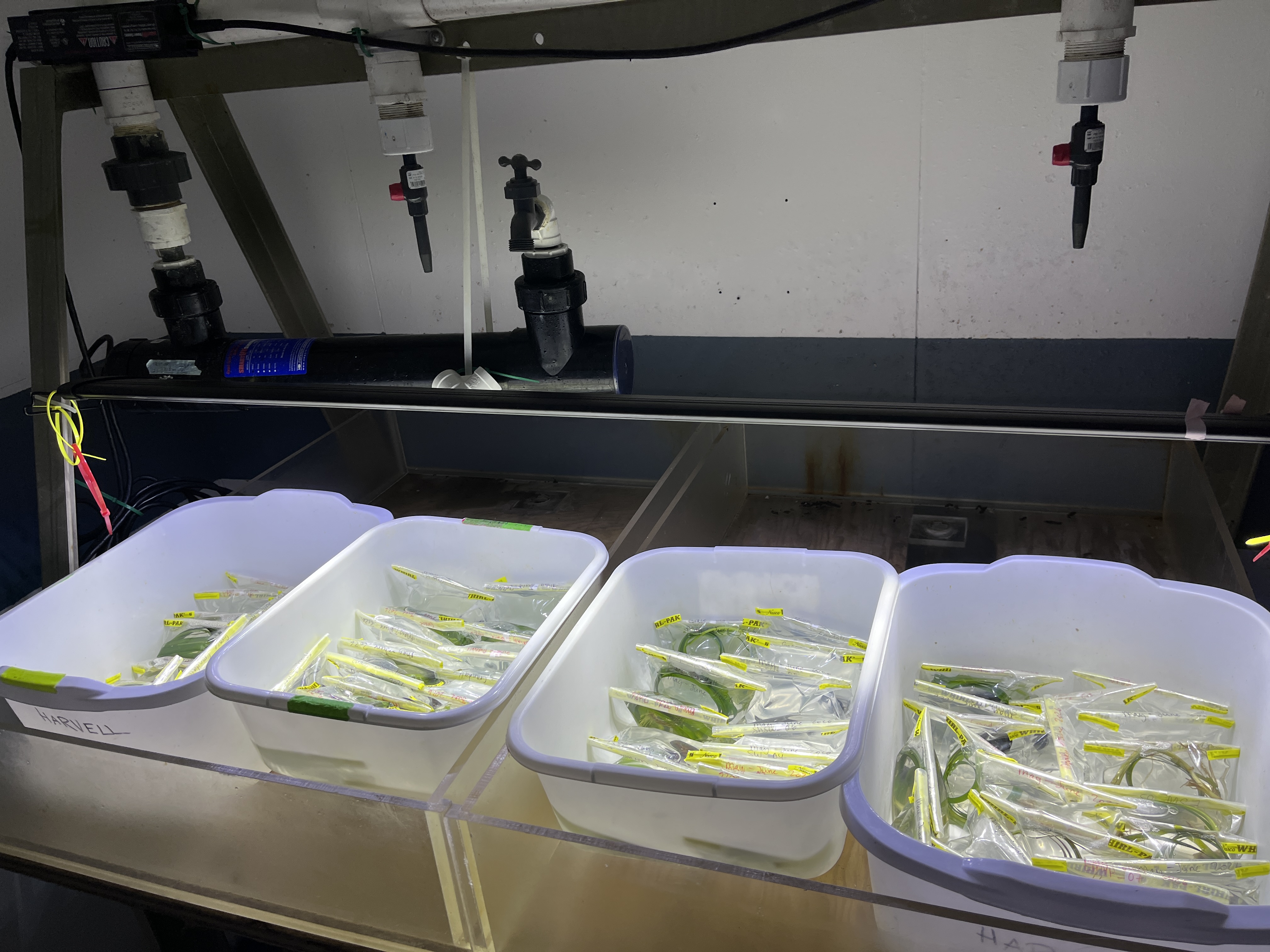
Timeline:
Inoculation happened at 1:30am on May 28th.
I checked them every day around 12:30pm.
Day 0.5: ~12:30pm May 29th –> plants photosynthesizing, mussels have byssal threads out
Day 1.5: ~12:30pm May 30th –> plants photosynthesizing, mussels have byssal threads out
Day 2.5: ~12:30pm May 31st –> plants photosynthesizing, mussels have byssal threads out
Day 3.5: I checked a little earlier (around 9am) and the mussels weren’t looking happy, so the experiment came down that day!!!
Takedown
Takedown was a ~12hour process that invovled setting up supplies and then actually sampling. I did this by myself!
Samples taken in the following order to prevent contamination (qPCR is sensitive!):
-
Control samples: Treatments 9, 8, 7, 4, and 1: took 0.45um filtered seawater samples, swabbed eelgrass tissue (4cm down from the tip of the longest blade, swabbed 4cm of tissue for 10s), and kept the mussels in the whirlpak bags to freeze at -80C
-
Exposed samples: Treatments 6, 5, 2, and 3: took 0.45um filtered seawater samples, swabbed eelgrass tissue (4cm down from the tip of the longest blade, swabbed 4cm of tissue for 10s), and kept the mussels in the whirlpak bags to freeze at -80C
Reason for eelgrass (and later shell swabs) is to see if V. pectenicida forms a biofilm on them.
Reason for whole body mussel sample is to see if mussels can accumulate V. pectenicida in their tissues.
Next steps:
Extract DNA
- Extract DNA from the seawater sample filters (n=75 (72 samples + 3 timepoint zero samples)): ZymoBIOMICS Miniprep Kit (D4300)
- Extract DNA from the swabs (n=32): DNeasy PowerSoil Pro Kit
- Extract DNA from mussel shell swabs (n=40): DNeasy PowerSoil Pro Kit
- Extract DNA from mussel whole body (n=32): Qiagen Blood and Tissue Kit
Run qPCR
Run 2ul from each of the above samples on qPCR targeting V. pectenicida.
Results
STAY TUNED!!!!